Wedding Planning
Can You Choose Your Wedding Band’s Setlist?
Rhona Downie · 2026-11-03 · 12 min read
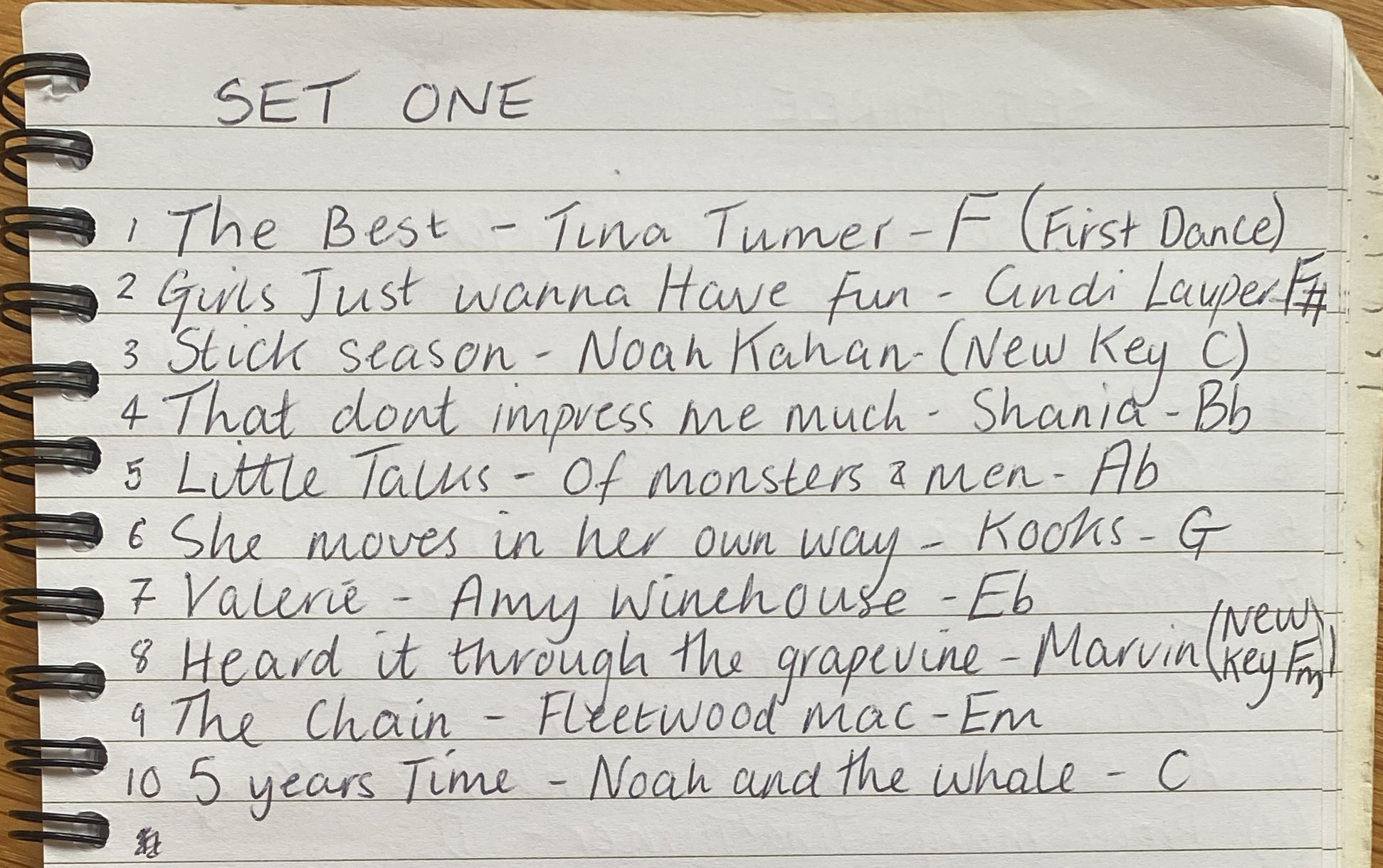
One of the most common questions couples ask when booking live wedding entertainment is: can you choose your wedding band’s setlist?
The short answer is yes—but how much choice you have depends on the band you book.
What is a wedding band repertoire?
A wedding band repertoire is the full catalogue of songs an act already knows and can perform confidently. The setlist is the shorter selection chosen from that repertoire for your event.
Some wedding bands perform a fixed, tried-and-tested show. Others invite you to suggest a handful of favourites. At The Supreme Collective, many of our acts offer an unusually flexible experience, with the band creating an almost completely bespoke setlist from the songs you select from their repertoire.
This level of choice is not always available—even from acts charging more than £10,000—so it is worth checking exactly how much input you will have before booking.
However, there is a difference between helping to shape the music and dictating every detail. The best results usually come from combining your knowledge of your guests with the band’s experience of performing live.
How much control will you have over the setlist?
Every act on The Supreme Collective is assigned one of three setlist-tailoring levels.
Signature Setlist
The band performs its signature setlist: a carefully developed collection of songs that it knows works brilliantly with a wide variety of audiences.
You may still be able to provide information about your musical tastes, but the band will largely take the lead. This is ideal if you want to relax and trust experienced performers to run the party.
Collaborative Setlist
You and the band shape the performance together.
As a general guide, around half of the set might be drawn from your selections, with the other half chosen by the band from its tried-and-tested repertoire. This provides plenty of personalisation while giving the musicians enough flexibility to create a balanced performance.
Fully Tailored Setlist
A fully tailored setlist is built almost entirely around your suggestions.
For many of our founding acts, clients are welcome to select all their favourite songs from the band’s repertoire. The musicians then use those choices to create a setlist that reflects the couple’s tastes while still working naturally as a live show.
These bands will commonly accommodate more than 90% of the client’s suggestions—and, in many cases, every suggestion that can fit into the available performance time.
You can find the relevant setlist information on each act’s profile before booking.
Why shouldn’t we dictate every song and its exact position?
You know your guests better than the band does. You know which songs have a personal meaning, which artists your friends love and which tracks will transport your family back to a particular time in their lives.
The band, however, brings a different kind of knowledge.
Professional musicians know which songs translate brilliantly from a recording to a live performance. They know which combinations keep a dance floor moving, which songs transition naturally into one another and which apparently popular choices can unexpectedly drain the energy from a room.
They also understand the practical demands of the performance.
A singer’s voice is part of their body. A setlist containing several vocally demanding songs in succession may look wonderful on paper but be unnecessarily punishing to perform. A well-constructed set gives vocalists—and the other musicians—moments to recover without the audience noticing any drop in energy.
Bands also have certain numbers that they know they perform exceptionally well. These arrangements may have been perfected over hundreds of performances. Removing all of the band’s discretion can mean missing the very songs and spontaneous moments that show the musicians at their best.
The ideal approach is therefore not to surrender all control, nor to prescribe every note. It is to give the band a clear picture of what you love and allow its members to apply their expertise.
That is how you get the most from the musicians you have hired.
How many song suggestions should we provide?
For a standard two-hour live performance, a wedding band will generally perform approximately 28–32 songs, depending on song lengths, arrangements, medleys and interaction with the audience.
We therefore recommend suggesting at least 32 favourites from the band’s repertoire. This gives the musicians a strong understanding of your musical taste and enough material to create your ideal performance.
You are also very welcome to suggest more.
If a band has hundreds of songs in its repertoire, you might want to review the entire list and use a simple traffic-light system:
- Green: songs you would really love to hear.
- Amber: songs you would be happy for the band to perform.
- Red: songs you would prefer the band to avoid.
We deliberately describe these as song suggestions rather than “must-plays”. Your green list tells the band what would delight you, without creating the expectation that every individual song is guaranteed regardless of what happens on the night.
What belongs on a do-not-play list?
Anything you genuinely do not want to hear.
Some mainstream artists and wedding favourites are enormously popular but also divisive. A song that fills the dance floor at one wedding might make another couple cringe—and it is your celebration.
A do-not-play list can include:
- Artists you strongly dislike.
- Songs connected with an unhappy or unsuitable memory.
- Styles that feel completely wrong for your event.
- Overplayed wedding tracks you would rather avoid.
- Songs containing lyrics you consider inappropriate for your guests.
There is no universally correct do-not-play list. Its purpose is simply to help the band understand your boundaries.
Keeping the list focused is helpful. Excluding a few particular songs or artists gives the musicians useful direction; excluding several entire decades and genres may significantly restrict their ability to respond to the audience.
How does a professional wedding band read the room?
The audience can see the band—but the band can also see the audience.
The musicians notice which songs bring people running towards the dance floor, which choruses have the room singing and which styles excite particular groups of guests. They watch faces, movement and energy throughout the performance.
An experienced band can respond immediately.
If the audience reacts enthusiastically to one artist, the musicians may move another song by that artist into the set. Sometimes a band member will casually play a recognisable riff between songs. If the crowd responds, the rest of the band might join in and turn it into a wonderfully spontaneous moment.
Our musicians will also often check in with the couple during a break. Guests may approach the stage with a request or let the band know what they are enjoying. The musicians can use that feedback to make small adjustments during the night.
This is one of the biggest advantages of live music: the performance does not have to feel like pressing play on a fixed recording. It can respond to the people in the room.
What if one of our chosen songs doesn’t suit the booked line-up?
Occasionally, a band may replace one of your suggestions with another song you have selected, or with something very similar.
This is normally done for a musical reason.
For example, you may have booked a compact three-piece line-up, while the original arrangement of a particular song relies heavily on both lead and rhythm guitar. The musicians might feel that the number would lose too much of its impact with the instrumentation available.
Rather than deliver a version that feels thin or underwhelming, the band may substitute a song that suits the selected line-up and showcases it properly.
The purpose is not to disregard your choices. It is to ensure that everything performed on the night sounds as good as it possibly can.
Can a wedding band learn a song that isn’t in its repertoire?
Usually, yes—but the precise allowance varies between acts.
Many bands include one off-repertoire request as part of the booking. This is commonly used for the couple’s first dance. Additional requests can often be learned for a modest fee, which will be shown in the Extras section of the act’s profile.
The price may depend on the number of musicians involved because every member needs time to learn, arrange and rehearse their part. A request for a six- or eight-piece band naturally involves more preparation than a request for a duo or trio.
Some acts include as many as three off-repertoire requests. This often relates to the size of their existing song catalogue: a band with a smaller repertoire may offer more new requests, while an act that already knows several hundred songs may include one.
It is always best to check the individual act profile rather than assume that the same policy applies to every band.
How do live first-dance requests work?
If your booking includes an off-repertoire request, it can usually be used for your first dance.
You add the song to your Event Sheet no later than one month before the event. This gives the musicians time to confirm the arrangement, learn their individual parts and schedule any necessary rehearsal.
Problems are extremely rare. In more than ten years of arranging live first dances, we have encountered very few requests that could not be accommodated in some form.
A band may occasionally recommend using the original recording if:
- The lyrics are in a language the vocalist does not speak.
- The song relies on a large orchestral arrangement.
- The production is heavily electronic or synthesised.
- The chosen line-up cannot recreate the essential character of the recording.
You can also choose to use the original recording for your first dance simply because that particular version means something to you. Having a live band does not mean the first dance must be performed live.
Can an overly rigid setlist go wrong?
It can.
A rigid setlist removes the band’s ability to react if the guests do not respond as expected. The couple may love a particular genre, but the wider wedding party might not engage with two hours of it. This can happen with any specialist style, from indie and rock to hip-hop and R&B.
It can also make the musicians more tense. Instead of concentrating on the audience and enjoying the performance, they are focused on following an inflexible list and worrying that one unavoidable alteration will disappoint the client.
The best bands are absolutely capable of working with detailed musical instructions. However, a performance is often at its most joyful when the musicians feel that their skill and experience are trusted.
Tell the band what you love. Tell them what you dislike. Give them the information that only you can know about your guests—and then leave enough room for the musicians to bring their own expertise to the celebration.
What is the difference between a song suggestion and a song request?
At The Supreme Collective, these terms have distinct meanings.
Song suggestions are your favourites from the band’s existing repertoire. They guide the musicians when they construct the setlist.
A song request is a specific song you want the act to learn outside its existing repertoire. Most bookings include a set number of these requests, and additional requests may be available as an optional extra.
Both your suggestions and any special request should be submitted through your Event Sheet by the stated deadline, normally one month before the performance.
When should we submit our choices?
As early as you comfortably can.
You do not need to decide upon your first dance or song suggestions before booking. Once your booking is confirmed, you can add ideas to your Event Sheet and amend them as your plans develop.
The band will review the final selections when you mark that section as complete or when the one-month deadline approaches.
Late changes are much harder to accommodate—particularly during the busy summer wedding season, when musicians may be performing several times each week. New requests need to be learned, arranged and sometimes rehearsed by an entire band, so a few days’ notice is rarely sufficient.
The more notice you provide, the better the chance of hearing exactly what you want.
So, can you choose your wedding band’s setlist?
Yes—with many of our acts, you can have an exceptional amount of input.
You may choose a band with a proven signature show, collaborate on a balanced mixture of your favourites and its strongest songs, or select a fully tailored act that builds almost the entire performance around your tastes.
Our advice is to be clear about the songs you love and the music you would rather avoid, while giving the band enough freedom to arrange the set, protect the vocal performance and react to your guests.
Your knowledge of the people in the room, combined with the musicians’ experience of creating a brilliant live performance, is what produces the best result.
Browse The Supreme Collective’s wedding and event bands and check each profile to see how its setlist can be tailored.
Looking for live music for your event?
Explore our wedding bands, party bands and live entertainment options for unforgettable celebrations.
Enquire now